


Why can two people experience the same event and react in completely different ways?
Two employees receive the same criticism.
One feels uncomfortable, thinks about what can be improved, and continues with the day.
The other spends hours replaying the conversation, thinking:
“I should not have made that mistake. My manager must think I am incompetent. If I fail at this, it proves that I am not good enough.”
The event is similar.
The emotional outcome is not.
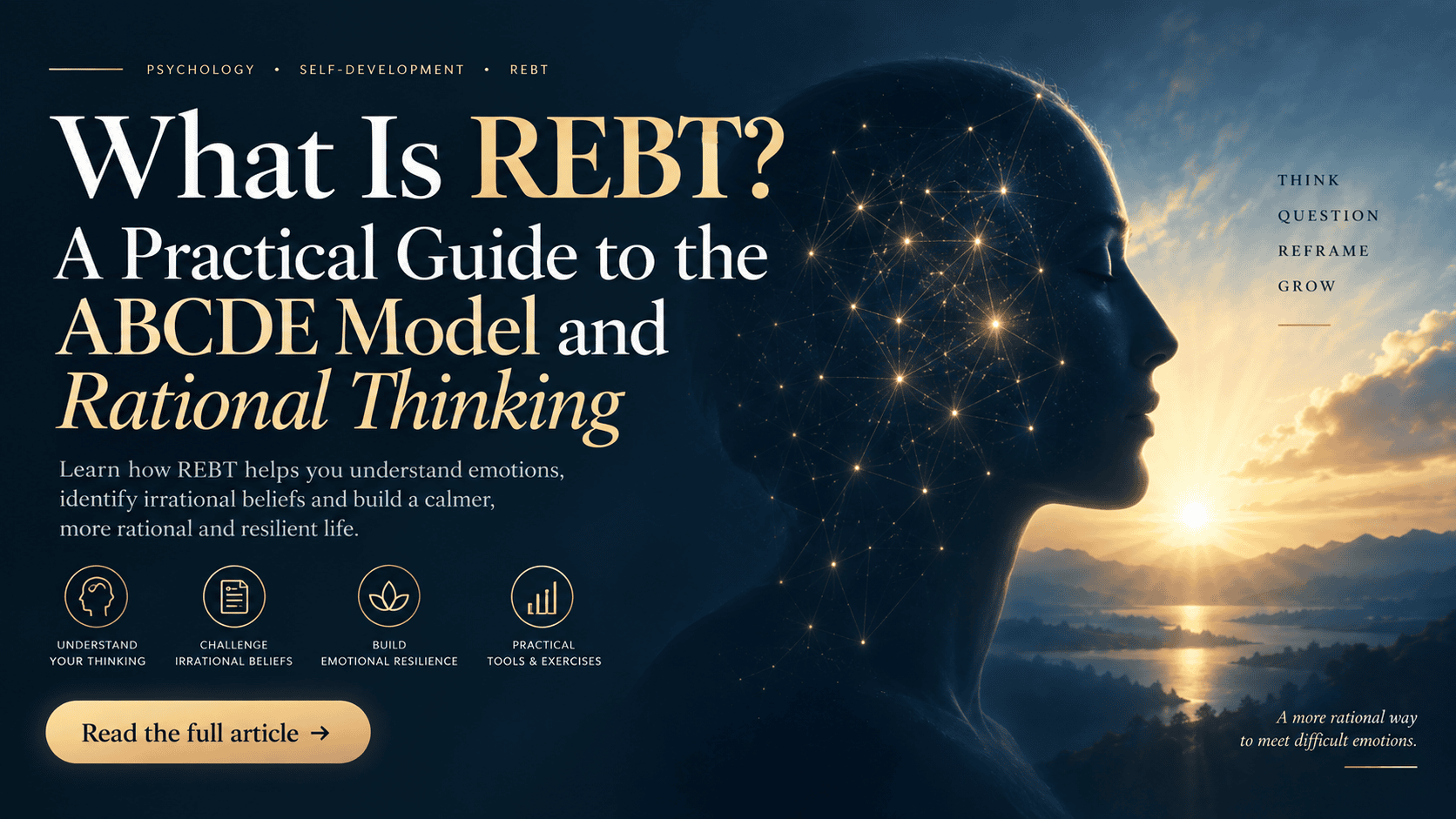
Rational Emotive Behaviour Therapy, usually known as REBT, begins with a deceptively simple idea:
Events matter, but our beliefs about events also shape how we feel and behave.
This does not mean that painful events are imaginary.
Loss is real. Rejection is real. Failure hurts. Uncertainty can be frightening.
REBT asks a different question:
What are we telling ourselves about what happened — and are those beliefs helping us respond more effectively, or creating an additional layer of suffering?
What Is Rational Emotive Behaviour Therapy?
REBT is a form of cognitive-behavioural psychotherapy developed by psychologist Albert Ellis in the twentieth century.
Its central focus is not merely on the events that happen to us, but on the beliefs through which we evaluate those events.
The method is active and practical.
Instead of only asking:
“Why do I feel this way?”
REBT also asks:
“What am I believing right now?”
and then:
“Is that belief logical, supported by evidence, and useful?”
The aim is not positive thinking.
REBT does not ask a person to replace an unpleasant truth with a pleasant fantasy.
It asks for something more demanding:
more accurate, flexible and rational thinking.
The REBT ABCDE Model
One of the best-known tools in REBT is the ABCDE model.
It provides a simple structure for understanding how emotional reactions develop and how they may be changed.
A — Activating Event
This is what happened.
Examples:
- someone criticised you;
- your partner did not answer a message;
- you made a mistake at work;
- you felt your heart beating rapidly;
- an important examination is approaching.
The activating event can also be internal.
A memory, bodily sensation or thought can become an activating event.
B — Belief
This is what you tell yourself about the event.
This stage is crucial.
Imagine that your partner has not replied to your message for several hours.
The fact is:
“I sent a message and have not yet received a reply.”
An interpretation may be:
“She is ignoring me.”
But beneath the interpretation there may be a deeper evaluation:
“She must not ignore me. If she does, it means I am not important. I cannot stand that.”
REBT is especially interested in this deeper evaluative layer.
C — Consequence
Consequences include:
- emotions;
- bodily reactions;
- further thoughts;
- behaviour.
A belief such as:
“She must answer me immediately, otherwise something is terribly wrong”
may contribute to anxiety, anger, compulsive checking or repeated messaging.
The important point is that C does not follow mechanically from A.
Beliefs at B influence what follows.
D — Disputation
Disputation means examining an irrational belief rather than automatically obeying it.
REBT commonly uses three forms of questioning.
1. Empirical disputation
Ask:
Where is the evidence?
For example:
“Where is the evidence that someone must always respond to me immediately?”
A strong preference is not the same thing as a law of reality.
2. Logical disputation
Ask:
Does this conclusion actually follow?
Example:
“I strongly want to succeed.”
does not logically imply:
“Therefore I absolutely must succeed.”
Similarly:
“I failed at one task”
does not logically become:
“I am a failure as a human being.”
3. Pragmatic disputation
Ask:
Where does this belief take me?
Does it help you solve the problem?
Or does it create panic, avoidance, resentment, procrastination or self-condemnation?
A belief can be examined not only for truth, but also for its consequences.
E — Effective New Philosophy
After an irrational belief is challenged, REBT develops a more flexible alternative.
Not:
“Everything will be fine.”
But something more realistic:
“I strongly want this to go well, but it does not have to. If it goes badly, I will be disappointed, but it will not be the end of the world. I can tolerate the discomfort, learn from what happened and continue.”
That is very different from forced optimism.
It accepts reality while reducing unnecessary psychological escalation.
The Four Main Irrational Beliefs in REBT
Although irrational beliefs can appear in countless forms, REBT often identifies four recurring patterns.
1. Demandingness
This is the language of rigid musts.
Examples:
“I must succeed.”
“People must treat me fairly.”
“My partner must understand me.”
“Life must not be difficult.”
There is nothing irrational about wanting success, respect or fairness.
The problem begins when:
“I strongly want this”
becomes:
“This absolutely must happen.”
A desire allows reality to be different.
A demand does not.
2. Catastrophizing
Catastrophizing turns something difficult into something psychologically enormous.
Examples:
“It would be terrible.”
“This would ruin everything.”
“It would be the worst thing imaginable.”
The rational alternative is not:
“It does not matter.”
It may matter enormously.
A more accurate statement is:
“This would be very painful and difficult, but it would not literally be the end of everything.”
3. Low Frustration Tolerance
This often appears as:
“I cannot stand this.”
But in many situations the person is already tolerating what they say they cannot tolerate.
A more precise formulation is:
“I strongly dislike this. It is difficult. But I can endure it.”
This may sound like a small linguistic change.
Psychologically, it is not.
One statement declares incapacity.
The other recognises discomfort without surrendering the ability to cope.
4. Global Rating
This happens when a person turns one behaviour or outcome into a judgement of the whole person.
“I failed, therefore I am a failure.”
“I was rejected, therefore I am worthless.”
“He behaved badly, therefore he is a completely bad person.”
REBT separates the evaluation of behaviour from the evaluation of the whole human being.
A mistake can be a mistake.
A poor decision can be criticised.
But a complex human being cannot accurately be reduced to one result.
REBT and Anxiety: The Demand for Certainty
Anxiety often contains a hidden demand:
“I must know that everything will be all right.”
But certainty about the future is impossible.
No one can obtain a guarantee that:
- a relationship will continue;
- an examination will go perfectly;
- other people will approve;
- no uncomfortable sensation will appear;
- nothing unexpected will happen.
REBT therefore shifts the goal.
Not:
“I must eliminate uncertainty.”
But:
“I would prefer a good outcome, I will prepare as well as I can, and I can tolerate the uncertainty that remains.”
This is not passivity.
It is rational preparation without demanding an impossible guarantee.
REBT and Panic: When We Become Afraid of Fear
Panic illustrates the ABCDE process particularly clearly.
A bodily sensation appears:
heart racing, dizziness, chest tightness, unreality.
That sensation may become the activating event.
Then comes the belief:
“This must not be happening.”
“Something terrible is happening.”
“I cannot tolerate this.”
The fear increases bodily arousal.
The stronger sensations then seem to confirm the catastrophic belief.
A cycle develops.
One important part of REBT work is therefore learning not only to respond differently to external situations, but also to one’s own anxiety.
Sometimes the secondary fear —
fear of becoming anxious again
— becomes more disruptive than the original anxiety.
Perfectionism: High Standards or Rigid Demands?
Perfectionism is often described as a virtue.
But REBT distinguishes between:
high standards
and
absolute demands.
A healthy standard might be:
“I want to do excellent work.”
An unhealthy demand may sound like:
“I must do this perfectly. If I make a mistake, it proves that I am incompetent.”
The second position can lead to:
- procrastination;
- endless revision;
- avoidance of difficult tasks;
- excessive checking;
- fear of evaluation.
Paradoxically, demanding perfect performance can interfere with performance.
A more rational position is:
“I want to do this very well, but I do not have to be perfect.”
Approval-Seeking and the Need to Be Liked
Most people prefer to be respected, loved and accepted.
REBT does not ask us to become indifferent to other people.
But there is an important difference between:
“I want your approval.”
and
“I need your approval in order to be acceptable.”
If approval becomes a psychological necessity, then every disagreement becomes dangerous.
Criticism becomes a verdict.
Rejection becomes evidence of worthlessness.
A more flexible belief is:
“I strongly prefer to be accepted, but another person’s opinion does not determine my worth as a human being.”
Unconditional Self-Acceptance
One of the most important ideas in REBT is unconditional self-acceptance.
It rests on a simple distinction:
You are not identical to your actions.
You may make a poor decision.
You may fail.
You may behave badly.
Those behaviours can be evaluated honestly.
But:
“I did something badly”
is not the same proposition as:
“I am a bad or worthless human being.”
Self-acceptance is not complacency.
It does not mean pretending that every action is acceptable.
In fact, people may be better able to examine mistakes when those mistakes are not treated as a verdict on their entire worth.
REBT Is Not Positive Thinking
This distinction matters.
REBT does not teach:
“Everything happens for a reason.”
It does not promise:
“Everything will be fine.”
It does not ask you to repeat statements you do not believe.
Instead, it aims for beliefs that are:
- realistic;
- logical;
- flexible;
- emotionally healthier;
- useful for action.
The goal is not to turn painful situations into pleasant ones.
It is to stop unnecessarily turning difficulty into catastrophe.
Understanding Is Not Enough
A person may understand REBT intellectually and still continue reacting in the old way.
That is not surprising.
Beliefs that have been rehearsed for years do not usually change after reading one paragraph.
Practical REBT therefore involves repetition and behavioural work.
Useful tools include:
- ABCD and ABCDE worksheets;
- identifying rigid demands;
- disputing irrational beliefs;
- writing rational alternatives;
- keeping a structured diary;
- behavioural experiments;
- exposure to tolerable discomfort.
The aim is for a new belief to become something a person can use when emotionally activated — not merely something they agree with while calm.
A Simple REBT Exercise You Can Try Today
Think of one recent situation that upset you.
Write down five things:
A — What happened?
State only the facts.
B — What did I tell myself?
Look especially for:
must, should, cannot stand, terrible, worthless.
C — What did I feel and do?
Be specific.
D — Challenge the belief
Ask:
Where is the evidence?
Does this logically follow?
Does thinking this way actually help me?
E — Write a rational alternative
Try this structure:
“I strongly prefer ________, but it does not absolutely have to happen. If it does not happen, it will be difficult and unpleasant, but I can tolerate it. This outcome does not define my entire worth.”
Then notice whether the emotional response changes.
The goal is not necessarily to feel good.
It may be to move from panic to concern, from self-condemnation to disappointment, or from rage to assertive dissatisfaction.
That is already meaningful change.
When Self-Help Is Not Enough
A handbook can be useful.
But it cannot replace professional assessment or treatment when symptoms are severe.
If emotional difficulties are persistent, substantially impair everyday functioning, involve loss of contact with reality, severe compulsive behaviour, overwhelming trauma, or thoughts of self-harm, professional help is needed.
REBT self-help and professional psychotherapy are not competitors.
They are different levels of support.
Learn REBT Step by Step
If you want a structured way to learn and practise these ideas, I created:
The REBT Handbook
A Practical Guide to Emotional Health, Rational Beliefs, and Inner Stability
The complete digital edition includes:
- 75 designed pages;
- 22 chapters;
- 12 appendices;
- ABCD and ABCDE worksheets;
- irrational-belief reference tables;
- rational-statement exercises;
- a 14-day REBT work diary;
- a structured 7-day practice plan.
Complete Digital Edition — €25
Milan Popović, MD
Psychiatrist & REBT Psychotherapist
FAQ ZA DNO STRANE
What does REBT stand for?
REBT stands for Rational Emotive Behaviour Therapy, a cognitive-behavioural psychotherapy developed by Albert Ellis.
What is the ABCDE model in REBT?
ABCDE stands for Activating Event, Belief, Consequence, Disputation and Effective New Philosophy. It is used to identify and challenge irrational beliefs.
What are irrational beliefs in REBT?
Common irrational beliefs include rigid demands, catastrophizing, low frustration tolerance and global rating of oneself or others.
Is REBT the same as CBT?
REBT belongs to the broader cognitive-behavioural tradition, but places particular emphasis on rigid evaluative beliefs such as demandingness, catastrophizing and global self-rating.
Can REBT help with anxiety?
REBT techniques are commonly applied to anxiety by examining catastrophic beliefs, demands for certainty and low frustration tolerance. Severe or persistent anxiety should be assessed by an appropriate healthcare professional.
Slične objave:
 Online REBT Therapy in English with a Psychiatrist
 Psychiatric Medication Refill in Serbia
 Psychiatric Medication Review and Prescription Renewal in Serbia
 Exploring the Cosmic Matrix: How Consciousness, Information, and Space-Time Intertwine in the Universe
 Sve što bi trebalo da znate o REBT psihoterapiji
 What are the 7 parts of the eye?
 Some questions about nutrition?
 the most common problems?
 Will I need more medical tests?
 Are Short Workouts Worth It?
A World With Only Optimized Experiences Is Just Boring
Are Short Workouts Worth It?
A World With Only Optimized Experiences Is Just Boring
 Could Eyedrops Replace Reading Glasses?
 A Revolutionary Change in Paediatric Healthcare
 Circulating vaccine-derived poliovirus type 2 (cVDPV2) – Algeria
 Is it okay to cleanse your body by fasting from time to time?
 Closing Ireland’s Mental Health Workforce Gap: Why Psychiatrists and CBT/REBT Psychotherapists Are Urgently Needed
- Tags:
- ABCDE model
- Albert Ellis
- anxiety
- approval seeking
- catastrophizing
- CBT
- cognitive behavioral therapy
- demandingness
- emotional regulation
- irrational beliefs
- low frustration tolerance
- perfectionism
- psychotherapy
- Rational Emotive Behaviour Therapy
- rational thinking
- REBT
- REBT exercises
- REBT handbook
- REBT workbook
- unconditional self-acceptance